













Why eggs, sperm and embryos cross borders – and why 2026 matters
When people picture IVF, they rarely picture a border. Yet more and more families move eggs, sperm or embryos between countries – to reach a clinic with particular expertise, to work with a donor available elsewhere, to pursue options their home country doesn’t permit, or simply because life moves and frozen material has to follow.
What many don’t realise until they are in it: the moment reproductive material crosses a border, it enters a web of rules. There are rules on consent, on screening and testing, on which clinics may send and receive it, and on what the destination country allows at all. Those rules differ from one country to the next – and 2026 brought some of the biggest shifts in years, with more expected in 2027.
This is a plain-language snapshot of where things stand today, written for intended parents and the professionals who support them. It isn’t legal advice. Because this area of law changes quickly, treat it as a starting point for the right questions, not the final word on your particular route.
The UK: licensed clinics both ends, and consent tied to the destination
In the United Kingdom, moving eggs, sperm or embryos in or out of the country is overseen by the Human Fertilisation and Embryology Authority (HFEA), under its General Direction 0006 on the import and export of gametes and embryos. Three conditions matter most for families:
- Licensed clinics at both ends. You can move material in or out of the UK only to or from an HFEA-licensed clinic, and your UK clinic must offer an import/export service. If the clinic abroad meets the HFEA’s requirements, permission is automatic; if it doesn’t, your clinic has to apply to the HFEA for special permission.
- Written consent tied to the destination. The person who provided the gametes (or whose gametes created the embryo) must have given written consent, not later withdrawn, for the material to be sent to the specific country where the receiving clinic sits. A general wish to “export” is not enough – consent is linked to where it’s going.
- A written warning that the law differs abroad. Before giving that consent, the provider must be told, in writing, that the rules on how the material may be used – and on the legal parentage of any resulting child – may not match UK law. This is the quiet but crucial step: your standing as a legal parent can shift the moment material leaves the country.
There is also a customs layer. HMRC treats gametes and embryos as traded goods when clinics move them across the UK border, so import and export paperwork sits on top of the HFEA’s own conditions – which is why clinics are often advised to work with a courier and, where needed, a customs agent who handle reproductive material specifically.
The US: it’s about the donor, and the state matters
In the United States, eggs, sperm and embryos are regulated by the Food and Drug Administration as human cells, tissues and cellular and tissue-based products (HCT/Ps), under 21 CFR Part 1271. The core requirements focus on the donor, not just the shipment:
- Donor eligibility screening – a health-history questionnaire and a review of records for risk factors.
- Communicable-disease testing – donors of eggs, sperm and embryos must be tested for a defined set of infectious diseases.
There are meaningful exceptions – for instance, material from a sexually intimate partner, or a directed donation to a known recipient, is treated differently – but screening and testing are the backbone. When material is imported into the US, it also goes through FDA entry review at the border, so testing records and documentation need to line up before it arrives.
One extra wrinkle: several US states add their own consent, record-keeping and reporting rules on top of the federal baseline. So “the US rules” really means “the FDA rules plus your destination state’s” – worth confirming early if a specific clinic is already chosen.
Where the surrogacy map is being redrawn (2026)
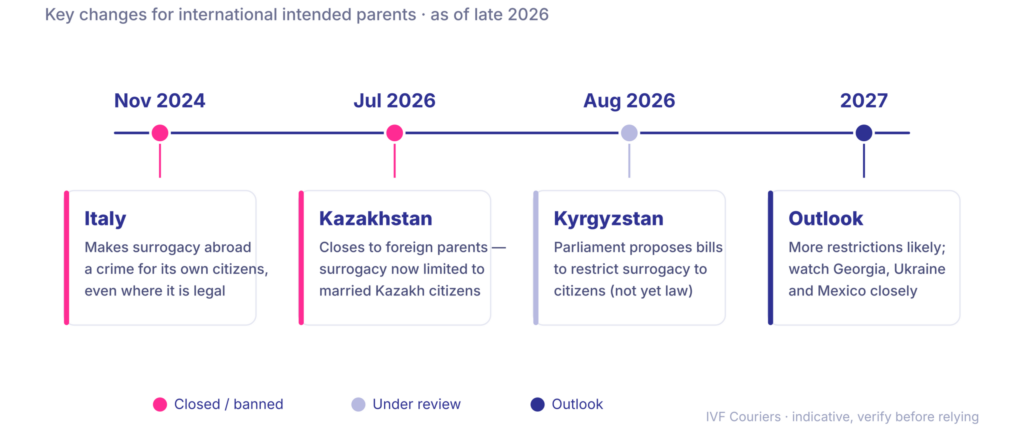
The frameworks above govern the move itself. A second kind of change can matter just as much: shifts in what the destination country – or your home country – permits in the first place. In 2026 the clearest of these came from Central Asia.
Kazakhstan closed its doors to foreigners. The country had become a rising destination for international intended parents, especially couples from China. Then President Kassym-Jomart Tokayev signed Law No. 350-VIII, and from 26 July 2026 surrogacy agreements may be entered into only by married couples who are citizens of Kazakhstan. The change followed a government inquiry that flagged exploitation and unregulated donor networks.
Kyrgyzstan looks poised to follow. In August 2026, members of its parliament proposed bills to restrict surrogacy to Kyrgyz citizens, citing Russia’s 2022 ban and Kazakhstan’s 2026 move as precedents. As of late 2026 these are still proposals, not yet law – but the direction is clear.
Of 153 surrogacy births recorded in Kyrgyzstan in 2024-2025, 138 were for foreign intended parents.
The pattern is regional, and it compounds. Each time a hub closes, demand concentrates on the few that remain open to foreign intended parents – Armenia and Georgia among them – which in turn invites fresh scrutiny there. Europe saw a parallel tightening in 2024, when Italy passed a law making surrogacy abroad prosecutable for its own citizens, even where it is legal.
For intended parents, the practical lesson is blunt: a destination that is open when you begin can close before you finish. Eligibility and parentage rules now move quickly, and they bear directly on where – and whether – reproductive material can travel. The “where” and the “how” of a cross-border move can’t be planned in isolation.
Where intended parents are going now: a 2026 destination map
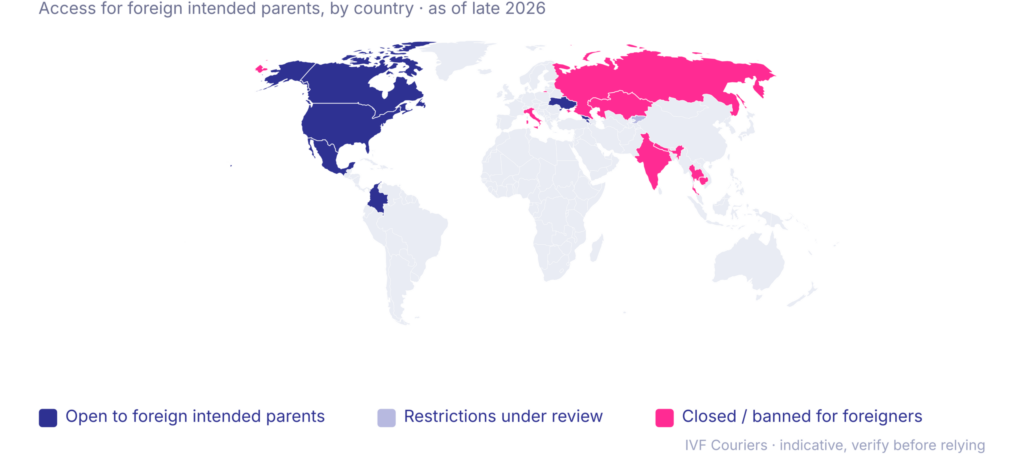
As the familiar hubs close, the practical question becomes simple: where is still open, and for whom? Below is an indicative snapshot of major surrogacy destinations as of late 2026, drawn from a range of country trackers. “Legal” in a country does not always mean “legal for you” – eligibility and legal routes vary widely, and, as this year shows, a status can change with a single bill or court ruling.
| Country | Open to foreign parents? | Who can qualify | Notes (late 2026) |
|---|---|---|---|
| United States | Yes, in surrogacy-friendly states | All family structures | Strongest legal certainty; rules set state by state; highest cost |
| Canada | Yes | All family structures | Altruistic only – no commercial payment to the surrogate |
| Mexico | Yes | All family structures | No federal law; court route varies by state; a Feb 2026 Supreme Court ruling backed a Mexico City pathway |
| Colombia | Yes | Singles and couples, including same-sex | Built on court precedent; a genetic link to one parent is required; parentage via post-birth court order |
| Ukraine | Yes | Married heterosexual couples (medical indication) | Strong protection for intended parents, but wartime and travel risk |
| Armenia | Yes | Married hetero couples; single women or men using their own gametes | Genetic link required; intended parents named at birth |
| Georgia | Yes | Married or long-cohabiting heterosexual couples | A 2023 bill to ban foreign surrogacy was never adopted – open, but watch closely |
| Kazakhstan | No, since 26 July 2026 | Married Kazakh citizens only | Previously a major hub, now closed to international parents |
| Kyrgyzstan | Under review | – | Parliament is weighing bills to limit surrogacy to citizens; not yet law |
| Russia | No, since 2022 | Citizens only | Closed to foreign intended parents |
| India, Thailand, Nepal, Cambodia | No | – | Each closed to foreign intended parents over the past decade |
| Italy | No | – | Bans surrogacy, and since 2024 prosecutes its own citizens who use it abroad |
For married heterosexual couples, the open routes now cluster around the US, Ukraine, Armenia and Georgia. Single parents and same-sex couples are steered mainly toward the US, Canada, Mexico and Colombia.
Practical takeaways: keeping a cross-border move on track
For intended parents and clinics alike, most problems trace back to the same few places. A short working checklist:
- Confirm both clinics are licensed and willing. The sending and receiving clinics each need to be recognised in their own system and set up to handle import/export. Not every clinic is.
- Get the consent paperwork right – and destination-specific. Written consent, tied to the exact country, signed and not withdrawn, plus any required notice that the law differs abroad.
- Match screening and testing to the destination’s standard, not just the origin’s. The receiving country may require particular tests or records; mismatches are a common reason material is delayed or turned back at the border.
- Check the destination’s eligibility and parentage rules, not only its transport rules. Confirm the treatment you’re planning is lawful there, and understand how legal parentage will be recognised, before anything moves.
- Build in time. Permits, certificates and customs clearance usually take longer than people expect, especially for moves in or out of a bloc (third-country moves).
- Use specialists who move reproductive material specifically. Temperature control, chain of custody and the paperwork leave little room for error; a general courier is not the same as one built for this.
What to watch in 2027
Three things are worth keeping in view as the year turns:
- Central Asia keeps tightening. With Kazakhstan closed since mid-2026 and Kyrgyzstan’s parliament weighing its own restrictions, pressure is likely to build on the hubs still open to foreign parents. Routes that look settled today could narrow next year.
- Watch the “open” destinations too. Georgia’s paused ban bill, Ukraine’s war, and Mexico’s state-by-state court routes all carry uncertainty. A destination that is open today can change with one vote or ruling.
- The trend is toward more rules, not fewer. Across surrogacy and specimen transport alike, 2024-2026 brought tighter oversight and heavier documentation. Planning on that assumption – and building in extra time – is the safer bet for any move in mind for next year.
A snapshot, not a rulebook – and where we come in
One honest caveat runs through everything above: this reflects the position in late 2026, and reproductive law changes often – sometimes quickly, sometimes with little warning. The specific requirements also depend on your exact origin, destination and circumstances. Before relying on any of it, confirm the current position for your route with your clinic and, where parentage or surrogacy is involved, with a fertility lawyer in the relevant country.
That moving target is exactly why this service exists. At IVF Couriers, a dedicated courier accompanies your eggs, sperm or embryos in the cabin for the whole journey – keeping them in sight and in custody from one clinic to the next – while we handle the permits, documentation and customs each border demands and keep track of the rules as they shift. If you’re weighing a cross-border move and aren’t sure what your route requires, we’re glad to talk it through.
Sources
- HFEA – Importing and exporting sperm, eggs and embryos
- US FDA – Reproductive tissue donation and 21 CFR Part 1271
- The Surrogacy Insider – Where is surrogacy legal in 2026 (world map)
- Law Society Gazette – Kazakhstan bans commercial surrogacy for foreigners
- Growing Families – Kazakhstan’s ban and the shift to remaining hubs
- open.kg – Kyrgyzstan: proposals to restrict surrogacy to citizens
- LLC Law (Georgia) – Surrogacy and IVF law in Georgia
- ANSA – Italy passes law making surrogacy a “universal crime”
- McGuireWoods – Donor tissue compliance in fertility labs (2026)